Sunday, June 12, 2016

It's National History Day This Week (and History Freebies)!


There's so many free ways to make history fun! The first thing to do is to visit the National History Day website at www.NHD.org. Each year a theme is chosen, and "Taking a stand in history" is the theme for this year. A free theme book is offered to teachers. Click here to get yours! Students can view projects, enter upcoming contests, and learn how to research history.

Another great free history project is the National Women's History Project with its goal of "writing women back into history". Information on the project can be found at www.nwhp.org. The theme for 2016 is: "Working to Form a More Perfect Union: Honoring Women in Public Service and Government". There are many historical women's resources and fun teaching ideas on this website.


Looking for free historical documents? Visit the U.S. History and Historical Documents website run by the U.S. Government at www.usa.gov/history. This website is like opening a treasure chest! It has timelines and descriptions of historical moments and famous speeches, as well as links to data, government branches, statistics, and much more. It is easy to navigate and loaded with interesting historical documents for students to explore and read.


Happy National History Day!
From Educator Helper

FREE History Handouts for National History Day:


Find other history projects, such as board games, historical comics, writing projects and more, at Educator Helper!

Monday, June 6, 2016

"Oh, you teach...you have summers off!"

Teachers hear the phrase escape lips every summer, "Oh, you teach...you have summers off!" Most of the general public have no idea what teachers do in the summer. There's activities to design, lesson plans to write, professional development to attend, summer school to teach...

First, many teachers must teach summer school to financially make ends meet. Lack of pay raises, decreasing benefits, higher retirement contributions, increasing healthcare costs (sometimes as high as $600.00 per month), along with crippling student loans for five-year teacher education programs in some states, has forced many teachers to take on extra after school duties and part-time jobs during the school year then teach additional classes in the summer. These overloads result in teacher burnouts and early retirements that lead to shortages and lack of highly qualified professionals in classrooms. But, that's only one duty teachers take on in the summer...


It seems as if every year there's a new quick-fix curriculum or better standards being touted! Some of these may work, but many times there is no one fix for classroom learning and management. Instead, teachers often spend their summers re-building their curriculum to meet new guidelines and to better engage students. Designing and/or finding excellent resources takes lots of time, and all materials must be aligned to constantly changing local, district, state, and federal standards. 

Go ahead, you non-teachers, and give lesson writing a try--put together an active learning, engaging, real life connected lesson plan that addresses low, middle, high, accelerated, gifted, English language learners, and special populations learning levels. Be sure to include outcomes and objectives that match, too! Then, write a lesson plan for every day you teach and for every class taught each day. Teachers can have as many as seven different classes in one day--that's 1,302 lesson plans per year!

Then, there's professional development that must be completed in order to remain certified to teach. It occurs on specific days at certain times only, so be prepared to rearrange your summer schedule for these courses. Otherwise, you'll be out of a teaching job the next school year. And, these aren't always free, either. Travel costs may or may not be paid by districts depending upon state funding and budget cuts. 

Okay, so I admit that my, and other teachers, summer is not all work and no play... But, the average number of hours teachers work daily during a school year can far exceed that of many other professions. 

By the way, I can't leave out that we have one of the most important jobs in society: teachers are in charge of molding and shaping the world's most precious resource--our children.  


Summer Freebies from Educator Helper TpT Storefront:


Click for complete lesson plan: Dog Walk Math!

Monday, May 30, 2016

In honor of Memorial Day... 20% off ALL items at Educator Helper TpT Storefront!

In honor of Memorial Day...
20% off ALL items at Educator Helper TpT Storefront!


Help students celebrate and honor the brave with:


Learn the difference between Veteran's and Memorial Day in this action verb, sight reading, get up and move story!


Monday, May 23, 2016

Have Fun Teaching Dialogue and Dialect

If you are used to "y'all", then your geographical location is a giveaway! I can't tell you how many times I've traveled north or west and been asked, "You are from Texas?" Actually, I'm from Oklahoma, a first cousin to my current home state of Texas. Regardless, when I open my mouth and speak, it's obvious I'm from the South. 

I was with a friend in Central Park in New York City. As we stood in front of a frozen pond, I said, "Look at all the ice!" However, he heard me say, "Look at all the i-ece!" He asked me to repeat the phrase four times. Finally, I spelled: I-C-E. My Southern pronunciation created a language barrier that produced lots of laughter and a great story to retell to my students. 

Some of our students have no out of state travel experiences. Therefore, they have no knowledge of regional dialect differences. Take time to use Dialects of the U.S. activities found below to introduce regional dialects for some active learning fun: 


For the full lesson plan, visit Dialects of the U.S.

Try more dialect activities:
Analyzing Images


Monday, May 16, 2016

Teach the "Why" Behind the Lesson

Have you ever been in the passenger seat of a car and wondered where your driver is headed, what route your driver will take, and what your driver has planned once you arrive at your destination? This is how students feel when they get introduced to the next lesson plan!

Tablet map

Students may not understand state numbers attached to objectives and outcomes, but they understand they must meet specific goals. Therefore, be sure to post daily objectives and goals where students can review them. Write these in the order taught/worked so that students can anticipate upcoming learning activities. 

For example, my students journal the first ten minutes of class time. During that time, they are not allowed to ask questions. They know once journals and sharing time is completed, questions are answered. Then, we begin work on active learning strategies in the order listed on the board. Now, they anticipate cooperative learning activities. 

Another "why" to teach students is grade-level state requirements. Once students understand that all seventh graders in the state are required to write research essays, the task becomes less ominous. Also, they understand "why" they must complete specific tasks. When "everyone else is doing it" then students understand certain state guidelines are met by students in all schools. 


When we think of explaining "why", state standards and requirements are often overlooked as being non-important to teach to students. But, before your next lesson, take time to explore "why" with students. 


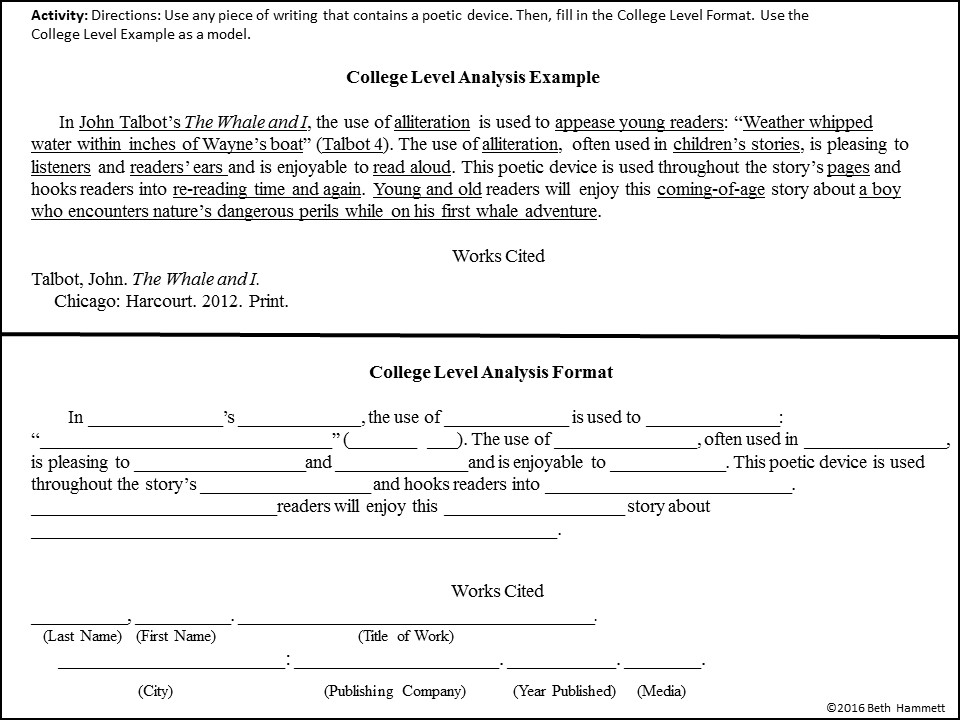
Take time to teach students the difference between middle/high school and college level writing with this lesson and activities--find the full lesson plan at: "What is College Level Writing?"


Looking for more great writing products?

FREE! Introduction Checklist for Literary Analysis
Understanding and Using Readability Levels
A Guide to Scholarly Research


Sunday, May 8, 2016

Combat Daydreamers with Active Learning Writing Strategies


Glazed eyes and open mouths are proof that students mentally check out as the end of the school year draws near. As teachers, we would like to join the ranks of daydreamers, but we must re-direct students to daily lesson plans. This is where active learning comes in handy!

For English classes, try meeting outdoors! There are so many fun, educational writing activities that can be done outside. Even rainy days can't detour Sidewalk Characters, which can be done under covered walkways or on butcher paper indoors as a last resort. This novel/short story active learning activity is FREE and fun!


Sidewalk Characters

Maybe you would rather do some creative writing outdoors! If so try some of these unique On Demand Writing Prompts to get students' imaginations flowing:


Surprise and engage students with out-of-the-ordinary writing activities! 

You'll be amazed at the creative writings students produce when their environment is stress free, and they are surrounded by nature. 

Enjoy outdoor writing!


More Journal Prompts: